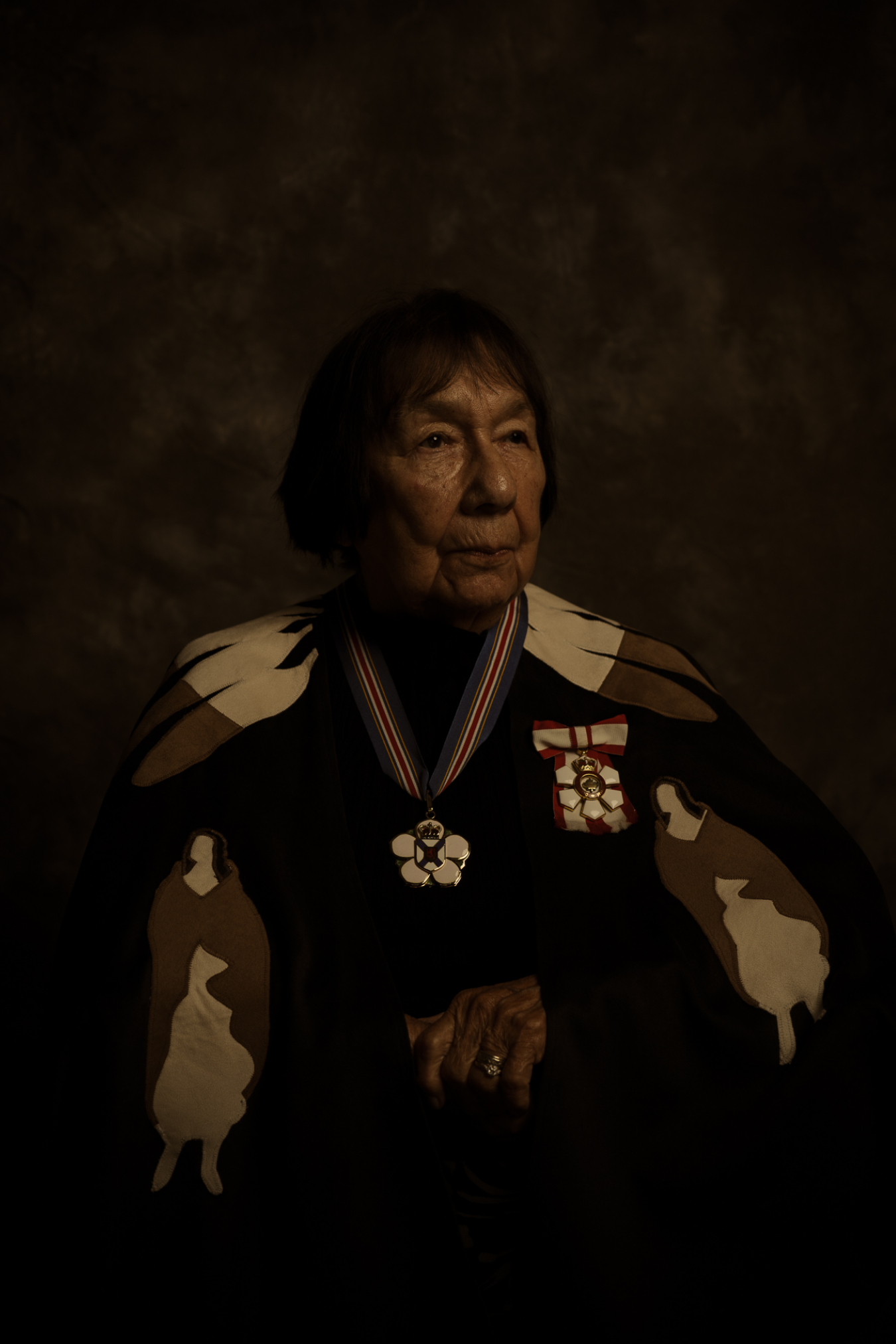
I was born in Cumberland County, Nova Scotia, in 1936. My family lived there until 1945, when we were relocated to the Indian Brook Reserve, now known as Sipekne’katik, as a result of the federal government’s centralization policy. When I think about my childhood, I think about my mother. My whole life was my mother. It was always the two of us—me and my mother. We travelled together by train and spent our days together. My mother spoke only our Mi’kmaw language, so even as a young girl, I became her translator. I was her connection to an English-speaking world, and she was my connection to everything that mattered. Then, when I was only thirteen years old, my whole life changed. My mother went to the hospital in Truro, and she never came home.

Suddenly, I was without the person who had been my entire world. Life would never be the same. Thankfully, I had a loving grandfather and an incredible uncle who took me under their care. But losing my mother so young also forced me to become strong and independent long before most children ever have to. I attended Sacred Heart Academy in Meteghan, Nova Scotia. I found my way there on my own, and I found my way home to my roots in Shubie on my own. I often had little or no money. I travelled by train, and the Sisters of Charity would sometimes gather enough money to help me get somewhere safely. Many times, I stopped in Digby, where members of my family clan would camp and sell baskets during the summer. I learned very young how to find my way.
Later, I attended Maritime Business College in Halifax. I married young and became the wife to a hard-working strong Mi’kmaw man from Yarmouth and became a mother. I had seven beautiful children, although motherhood also brought unimaginable loss. I lost one of my babies in infancy. Years later, my son died at the age of forty-seven in a fishing tragedy at sea off the coast of Yarmouth. My beautiful daughter died from cancer at the age of fifty-six. There are losses a mother never truly gets over. You simply learn how to carry them. One of the memories of my own mother that has stayed with me throughout my life is her telling
me, as a little girl, to go to school, learn to speak good English and work hard. She wanted the best life for me. And in many ways, I did exactly what she told me to do.

My husband and I raised our young family during exceedingly unsuitable times. We were raising Mi’kmaw children during an era when there was tremendous racism. There were times when people hid who they were because being Mi’kmaw could bring discrimination, shame, and hardship. There were times when my husband and I could not find a safe home to live due to discrimination. But those experiences did not make me harsh or turn away from raising my family in this Province living off reserve, those experiences made me even stronger. The trials of my life led me down a road of empowerment. They gave me a deep determination to fight for the rights of Mi’kmaq, Mi’kmaq living off reserve and particularly for the rights and voices of Mi’kmaw women. For more than fifty years, I worked for our people, within our communities and nationally. I served on the Royal Commission on Aboriginal Peoples and devoted much of my life to advocacy, leadership, and creating change. Education, too, remained part of my journey. I received my first Doctorate of Laws from Dalhousie University and then returned to the same university and earned my law degree in 1998—an accomplishment I worked incredibly hard for and one of which I remain deeply proud.
Over the years, I have been honoured to receive recognition for my work, including the Order of Nova Scotia and the Order of Canada, as well as many other Awards for my contributions to our Mi’kmaw people, Indigenous rights, and Canadian society. Most recently, I received an honorary Doctor of Civil Laws from Acadia University. But after all the titles, awards, meetings, committees, struggles, and accomplishments, I have come full circle. Today, after a lifetime of serving my people and caring for my family, I live with my youngest daughter in the Yarmouth Mi’kmaw community. My grandchildren, great-grandchildren and great-great-grandchildren are part of my everyday life. I still sit on Mi’kmaw advisory boards. I still attend as many events as I can. I still travel when I am able and most importantly, I spend time surrounded by my beautiful family. When I look back, I think about that little Mi’kmaw girl travelling by train with her mother, translating English for her because Mi’kmaw was the only language her mother knew. I think about the thirteen-year-old girl who lost her mother and suddenly had to find her own way. I think about the young mother raising Mi’kmaw children during a time when people were sometimes afraid to say who they were.

And I think about the woman I eventually became, a woman who spent more than fifty years standing up for her people. I needed to be strong, strong enough to survive the obstacles that I would face as a Mi’kmaw Woman, I did it all in my mother's Memory, with my Faith and with my Family I did.